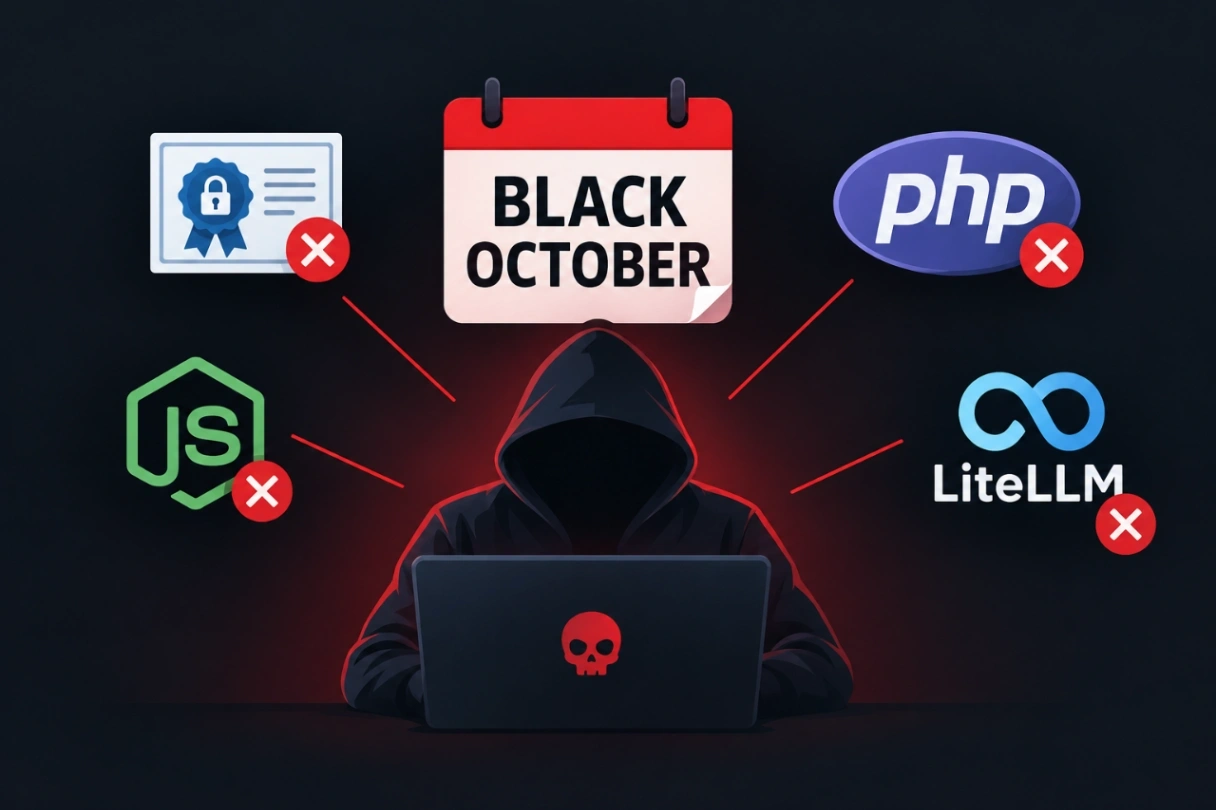
Black October 2026: When Software, Certificates, and AI Security Went Wrong
October 2026 brought several major cybersecurity incidents involving digital certificates, PHP vulnerabilities, Node.js, and a supply-chain attack on LiteLLM. Known as Black October, these events show how a small weakness in trusted software can create serious risks for applications, cloud infrastructure, and developers.
Advertisement
On this page
Black October 2026: When Software, Certificates, and AI Security Went Wrong
October 2026 has been a serious reminder that cybersecurity problems can come from places we trust every day.
From digital certificates that help browsers identify trusted websites to vulnerabilities in PHP and Node.js, several major security incidents happened within a short period. There was also a supply-chain attack involving LiteLLM, a popular tool used to connect applications with different AI models.
These events are being described together as Black October.
But why does this matter to developers, DevOps engineers, cloud engineers, and people who manage production systems?
Let's break it down in simple English.
What is Black October?
Black October is a name used to describe a series of major cybersecurity incidents reported during October 2026.
The incidents affected different parts of the technology ecosystem:
- Digital certificate infrastructure used to establish trust.
- PHP applications running on web servers.
- Node.js applications processing compressed data.
- Software packages and container images used by developers.
At first, these problems might look unrelated. One involves certificates, another involves application code, and another involves software distribution.
However, they share an important lesson: when software or infrastructure that people trust has a weakness, the impact can spread far beyond the original problem.
Let's look at each incident.
Advertisement
1. eMudhra: When Digital Trust Becomes a Security Risk
Most people visit websites without thinking about how their browsers decide whether those websites can be trusted.
When you open an HTTPS website, digital certificates help your browser verify the website's identity and establish a secure connection.
Certificate Authorities, commonly called CAs, play an important role in this process. They issue certificates that browsers and operating systems use to verify digital identities.
What happened?
According to reports described in the Black October timeline, security researchers discovered that private keys associated with eight intermediate certificates operated by India's eMudhra were cryptographically weak.
The problem was linked to insufficient randomness during key generation.
In simple terms, cryptographic keys need to be generated using sufficiently unpredictable values. If the process is weak, an attacker may be able to recover a key that should be secret.
If an attacker obtains a certificate authority's private key, they may be able to create fraudulent certificates that vulnerable clients could trust.
That creates a serious problem because digital certificates are part of the foundation of internet security.
Google Chrome and Mozilla Firefox responded by blocking or revoking the affected certificate authorities through their respective security mechanisms.
eMudhra stated that the affected intermediate authorities had not issued end-entity certificates and that it had found no evidence of a breach of its infrastructure or customer data. The company subsequently announced its withdrawal from the global SSL/TLS certificate business.
Why should DevOps engineers care?
This incident shows that security does not depend only on application code.
It also depends on the infrastructure that establishes trust between systems.
For DevOps and platform engineers, this is a reminder to understand certificate lifecycles, monitor certificate expiry and revocation, and know how applications and containers obtain their trusted certificate stores.
The lesson: A secure application still depends on the security of the systems and identities it trusts.
2. PHP2Shell: A Vulnerability That Could Put Web Servers at Risk
PHP is widely used to build websites, web applications, and backend services. Many applications depend on it to process requests and execute application logic.
Because PHP runs on servers that may be exposed to the internet, serious vulnerabilities in the PHP interpreter can have a broad impact.
What happened?
On October 21, 2026, the PHP development team released emergency security updates for two critical vulnerabilities known collectively as PHP2Shell.
The reported vulnerabilities were identified as CVE-2026-109618 and CVE-2026-109619.
According to the published incident summary, the flaws involved memory-management errors that could potentially allow an unauthenticated attacker to execute arbitrary code on a vulnerable server.
Let's make that easier to understand.
Imagine a web server running a vulnerable version of PHP. An attacker sends a specially crafted request that triggers a flaw inside the PHP interpreter.
If the vulnerability is successfully exploited, the attacker may be able to make the server execute code that the application was never supposed to run.
Depending on the server's permissions and configuration, this could put application data, credentials, and other resources at risk.
The reported research demonstrated serious exploitation scenarios involving popular platforms such as WordPress, Drupal, and Joomla.
What should DevOps teams do?
This is where patch management becomes extremely important.
If you manage PHP applications in production, you should:
- Identify which servers and container images run affected PHP versions.
- Upgrade to the appropriate patched version.
- Rebuild and redeploy container images instead of relying only on changes inside running containers.
- Check whether your AMIs or other base images contain outdated PHP packages.
- Review application and server logs for suspicious activity.
- Verify that deployments are healthy after patching.
If you use immutable infrastructure, update the image used to create your servers and roll out the patched image through your normal deployment process.
Simply updating a package on one server is not enough if your autoscaling group continues launching new instances from an outdated image.
The lesson: A patch is only effective when it reaches every affected production environment.
3. Node2Shell: Why Processing Untrusted Data Can Be Dangerous
Node.js powers many APIs, backend services, automation tools, and modern web applications.
Applications often receive compressed data to reduce network usage and improve performance. Brotli is one of the compression formats used for this purpose.
But whenever software processes data supplied by another system, it must handle that data safely.
What happened?
On October 21, 2026, Node.js released security updates addressing several vulnerabilities, including a serious issue in its bundled Brotli decompression implementation.
The issue became known as Node2Shell.
The reported vulnerability involved an out-of-bounds write. In simple terms, this means software attempts to write data outside the memory area it is supposed to use.
Depending on the circumstances, this type of memory corruption can cause a program to crash, expose information stored in memory, or potentially allow an attacker to execute code.
Researchers subsequently reported a successful remote-code-execution demonstration against a vulnerable Node.js environment. The patched release rejected the same malicious input.
Why does this matter for backend and cloud systems?
Think about a Node.js API running inside a Docker container on Kubernetes.
The API receives a request, processes compressed data, and passes the result to the application.
If the affected code can be reached through attacker-controlled input, the application may be exposed even if the business logic itself looks correct.
Running inside a container does not automatically eliminate the vulnerability.
Container isolation can reduce the impact, but the outcome still depends on the container's permissions, runtime configuration, available credentials, and network access.
What should engineers check?
- Identify the Node.js versions used by applications and base images.
- Upgrade to the appropriate patched release.
- Rebuild and redeploy affected container images.
- Check whether externally supplied compressed data reaches vulnerable code.
- Run containers with limited privileges and avoid unnecessary access to host resources.
- Review application logs and monitoring data for unusual crashes or behaviour.
For teams using Kubernetes, it is also worth checking whether old images are still running in deployments, jobs, or scheduled workloads.
The lesson: Processing data is not harmless just because it arrives through a normal application request.
Advertisement
4. LiteLLM: A Software Supply-Chain Attack
This incident is especially relevant to teams building AI applications.
LiteLLM is an open-source tool that helps applications communicate with different large language model providers through a common interface.
Developers may install it as a Python package or use it through container images.
That convenience also creates a dependency on the security of the project's release and distribution process.
What happened?
On October 21, 2026, attackers compromised LiteLLM's release infrastructure and distributed a malicious version of the package, identified in the incident reports as version 1.107.0.
Compromised container images were also distributed through Docker registries.
The reported malicious software was designed to steal sensitive information, including developer credentials, cloud secrets, authentication tokens, browser credentials, and AI service API keys.
According to the incident reporting, attackers obtained developer credentials and manipulated the project's release workflow to publish malicious software.
This is what makes a software supply-chain attack particularly dangerous.
Instead of directly attacking every company that uses a package, an attacker compromises a trusted point in the software distribution process. Users may then install the malicious package while believing they are installing legitimate software.
Why is this dangerous for DevOps and AI teams?
Consider an application that uses LiteLLM to connect to an AI provider.
The application might have access to:
- Cloud credentials.
- AI provider API keys.
- Database passwords.
- Internal service tokens.
- CI/CD environment variables.
If malicious code runs in an environment containing these secrets, it may attempt to steal them.
The consequences can extend beyond the original package. Exposed credentials may give attackers access to other services, depending on the permissions attached to those credentials.
What should teams do?
If your environment may have used an affected release:
- Check package versions, installation records, and container image digests.
- Compare them with the official incident guidance to determine whether the environment was affected.
- Isolate potentially compromised environments while investigating.
- Rotate credentials and tokens that may have been exposed.
- Rebuild affected environments from trusted packages and verified images.
- Review cloud audit logs, CI/CD logs, and authentication activity for suspicious access.
- Pin dependencies and verify package provenance where supported.
Do not assume that upgrading the package alone makes a previously compromised machine safe. If malicious code already ran, secrets may already have been exposed.
The lesson: Trusting an open-source project does not remove the need to verify what you install and execute.
What connects all these incidents?
At first glance, the incidents seem very different.
One concerns digital certificates. Another concerns a programming language runtime. Another involves data decompression, while the fourth targets software distribution.
But there is a common theme.
Security depends on every layer of the technology stack, not just the application you build.
Here is a simple comparison:
| Incident | Main weakness | Potential impact |
|---|---|---|
| eMudhra | Weak cryptographic private keys | Fraudulent certificates and broken trust |
| PHP2Shell | PHP interpreter vulnerabilities | Potential remote code execution |
| Node2Shell | Memory corruption in Brotli processing | Crashes, memory exposure, or potential code execution |
| LiteLLM | Compromised software distribution | Credential theft and exposure of connected services |
These incidents also show why security needs to be part of everyday engineering work rather than something teams address only after a major incident.
What DevOps Engineers Can Learn from Black October
You do not need to be a full-time security researcher to improve the security of your infrastructure.
A few practical habits can make a meaningful difference.
1. Know what is running in production
Maintain an inventory of the software versions used by your applications, container images, virtual machines, and deployment pipelines.
You cannot patch a vulnerability reliably if you do not know where the affected software is running.
2. Treat container images as software dependencies
A Docker image may contain vulnerable operating-system packages, outdated runtimes, and third-party libraries.
Scan images, use trusted base images, rebuild them regularly, and deploy verified versions.
3. Protect secrets properly
Avoid storing long-lived credentials directly in source code, Docker images, or build logs.
Use appropriate secret-management systems, limit permissions, and rotate credentials when exposure is suspected.
Remember that environment variables alone are not a complete secret-management solution.
4. Improve your patching process
A practical patching workflow should include:
- Identifying affected assets.
- Checking the severity and exploitability of the issue.
- Testing the update.
- Deploying it safely.
- Verifying that the patched version is running.
- Keeping evidence of the change.
For production environments, patching should be a repeatable process rather than a manual activity performed under pressure.
5. Make your CI/CD pipeline more secure
Your pipeline has access to code, packages, deployment permissions, and sometimes production credentials.
Protect developer accounts, use multi-factor authentication, restrict publishing permissions, and review changes to release workflows.
Where possible, verify package signatures, provenance, and container image digests.
6. Monitor for more than application errors
Monitoring should help you identify unusual authentication attempts, unexpected outbound connections, suspicious privilege changes, and unexpected access to secrets.
Logs and alerts cannot prevent every attack, but they can help teams investigate incidents and reduce the time it takes to respond.
Final Thoughts
Black October is a reminder that modern systems are connected in ways that are easy to overlook.
A weakness in certificate generation can affect internet trust. A flaw in a language runtime can put web applications at risk. A memory-safety problem can turn data processing into a security concern. A compromised package release can expose credentials across an entire development environment.
For developers and DevOps engineers, the answer is not to stop using open-source software or assume that every dependency is dangerous.
The answer is to understand our dependencies, reduce unnecessary privileges, keep systems updated, protect secrets, and build security checks into the way we develop and deploy software.
We cannot prevent every vulnerability from being discovered.
But we can build systems that are easier to patch, harder to compromise, and better prepared to recover when something goes wrong.
Security is not a one-time task. It is part of running reliable software.
References
- Black October — Wikipedia
- PHP official website
- Node.js official website
- LiteLLM documentation
- Google Security Blog
- Mozilla Security Blog
Note: This article summarizes the reported incidents and their potential implications. For patching or incident response, consult the relevant project's official security advisories and incident reports for the latest verified guidance.
Advertisement
Related Articles

Nginx vs Apache: Why One Handles Millions of Requests and the Other Struggles
Shiva • 7 August 2026
A factual breakdown of how Nginx and Apache handle incoming requests differently, why Nginx scales better under heavy concurrent load, and when Apache still makes sense

PostgreSQL vs MySQL: Threads vs Processes - How Each Database Handles Connections
Shiva • 2 August 2026
Understand the core architectural difference between PostgreSQL and MySQL: PostgreSQL uses a process-per-connection model with fork, while MySQL uses a thread-per-connection model inside a single process. Learn how this impacts memory, performance, connection pooling, and which database to choose.

How Netflix Delivers Streaming at Scale: The Open Connect Appliance
Shiva • 1 August 2026
Learn how Netflix's Open Connect Appliances (OCAs) power seamless streaming for millions of users. This beginner-friendly guide explains Netflix CDN architecture, the OCA hardware and software stack, health-based routing, and the DevOps lessons of building replaceable, self-healing infrastructure.

Grafana Git Sync: Manage Dashboards as Code with Git
Shiva • 2 May 2026
Learn how Grafana Git Sync helps teams manage dashboards using Git. Track changes, collaborate better, automate deployments, and keep dashboards backed up with version control.

Multiple High Severity Vulnerabilities in NGINX – Remote Code Execution & DoS Risk
Shiva • 4 April 2026
Multiple high-severity vulnerabilities have been discovered in NGINX Open Source and NGINX Plus that could lead to memory corruption, remote code execution, and denial of service attacks. Organizations using affected versions should update immediately.